 Daniel Mitchell
Key Takeaways
- A motor coupler is designed to be the weakest part in the drivetrain — it is meant to fail before the motor or transmission does.
- The tell-tale symptom is a motor that runs and can be heard while the drum does not turn, or turns with no resistance.
- Replacing a motor coupler is one of the clearest "worth it" repairs on a KitchenAid washer, since the part is inexpensive and the job is quick once diagnosed.
- A clutch or suspension fault looks similar but the drum still moves, usually with thumping rather than a free-running motor sound.
- Ignoring a broken coupler can grind debris into the transmission housing, turning a small repair into a larger one.
The Bottom Line
Is a KitchenAid washer motor coupler worth replacing? Almost always yes — it is a cheap, deliberately sacrificial part, and the fix is quick once a diagnostic confirms the drum is not turning for exactly that reason.
Yes, in nearly every case — a KitchenAid washer motor coupler is one of the cheapest parts on the entire machine, and it is also one of the most misdiagnosed. This guide is about a single part, not the whole washer: a plastic-and-rubber coupling that sits between the motor and the transmission on direct-drive models, deliberately designed to be the weakest link in the drivetrain so that it fails before the motor or the transmission does.
| Symptom | Likely part | Worth fixing? |
|---|---|---|
| Motor hums, drum does not turn | Motor coupler, most likely | Yes — cheap, quick |
| Motor runs, drum spins but tub barely moves | Clutch or suspension, different part | See our clutch guide |
| Grinding noise, motor labors | Coupler debris in the gap | Yes, before it spreads |
| No motor sound at all | Not the coupler — electrical fault | Needs diagnosis first |
What Does a Motor Coupler Actually Do?
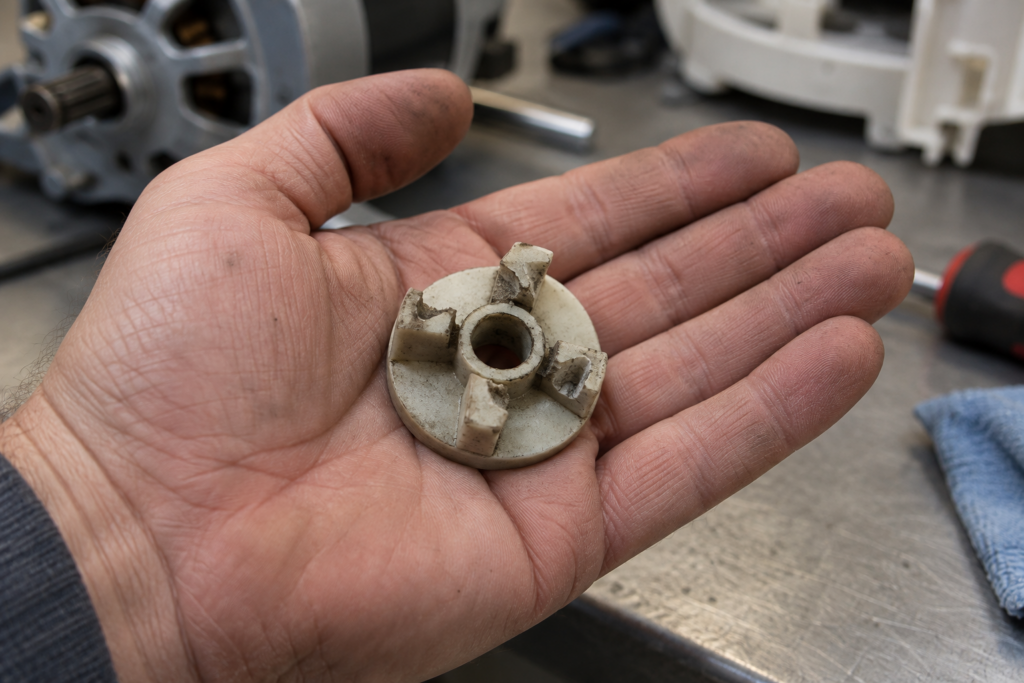
It connects the motor shaft to the transmission input shaft on a direct-drive KitchenAid washer, and it is built from a plastic coupling with rubber inserts specifically so that it wears out and breaks before something expensive does. That is not a design flaw — it is the intended failure point, the same idea as a fuse protecting a circuit. When the load is too heavy, or the machine has been off-balance for a long time, the coupler is what gives.
The symptom is distinctive once you know it: the motor runs and you can hear it, but the drum either does not turn at all or turns with far less force than it should. That single symptom is worth remembering, because it is what separates a coupler problem from almost everything else that can go wrong with a top-load washer.
Is a KitchenAid Washer Motor Coupler Worth Replacing?
Yes. This is one of the clearest "worth it" answers on this entire site, because the part itself is inexpensive relative to almost any other washer repair, and the alternative — living with a machine that will not spin — is not really an alternative at all. A diagnostic visit starts from $95, and confirming the coupler as the cause typically takes only a few minutes once the cabinet is open, because the failure is visible: broken or worn plastic tabs, sometimes with rubber fragments loose in the housing.
- The part itself is cheap relative to a transmission, a motor or a control board.
- The repair is fast once diagnosed, typically well under an hour of labor.
- It does not indicate a dying machine. Unlike a bearing or a transmission fault, a coupler failure is often the washer's normal wear-and-tear cycle working exactly as designed.
- Ignoring it does not save money. Running the motor against a broken coupler can grind debris into the transmission housing, turning a small job into a bigger one.
- It rarely comes alone for long. A washer left running against a broken coupler for weeks can eventually wear the transmission input shaft it was protecting in the first place.
- Parts are widely available. This is one of the most commonly stocked parts for direct-drive KitchenAid washers, which keeps turnaround short.
- It is a known, well-documented failure. A technician recognizes this pattern immediately rather than needing extended diagnostic time.
Compare that to almost any other washer repair on this site and the coupler stands out as the cheapest structural part in the drivetrain. A transmission failure, a suspension rebuild or a control board replacement all sit well above what a coupler job typically runs, which is exactly why this guide answers "worth it" so plainly where a whole-appliance question would need more nuance.
How Do I Know If It Is the Coupler or Something Else?
The coupler is not the only part that can make a top-load KitchenAid washer misbehave during the spin cycle, and telling it apart from a clutch or suspension problem is mostly a matter of listening carefully. A coupler failure sounds like the motor running freely with nothing resisting it — almost too smooth, with no drum noise at all. A clutch or suspension problem usually still moves the drum, just weakly or unevenly, and often comes with a thumping or squealing sound the coupler does not make.
We already cover that second case in detail in our guide to a KitchenAid washer where the motor runs but the tub barely moves — read that one if the drum is turning weakly rather than not at all, because the clutch and the coupler are different parts with different repairs, even though both produce a washer that will not spin properly.
Overloading is the single most common reason a healthy coupler eventually gives out, which is worth knowing before the replacement rather than after it fails again. A washer stuffed past its rated capacity, or one that regularly runs with a heavily unbalanced load of bedding or towels, puts far more torque through the coupler than a normal wash cycle does. None of that shortens the life of the transmission or the motor the way it shortens the life of this one deliberately sacrificial part — which is again the point of the design, but it does mean a second coupler failure within a year or two is often a loading habit rather than a defective part.
- Run a spin cycle with the lid open if the model allows it, and listen at the base of the machine.
- Note whether the drum moves at all or is completely still while the motor runs.
- Listen for grinding versus thumping. Grinding suggests coupler debris; thumping suggests clutch or suspension.
- Do not keep running loads once you suspect either fault — both get worse, not better, with continued use.
- Check the load size before the next wash. A machine that has just failed once is worth running lighter loads on until it is repaired.
- Write down the exact sound and when it happens in the cycle — at the start, during agitation, or only during spin — since that timing narrows the diagnosis further.
Getting It Checked
A motor coupler sits underneath the cabinet, between the motor and the transmission, and reaching it means removing panels and often the whole cabinet shell — not a job to start without the right tools already in hand. Our KitchenAid washer repair service diagnoses the coupler, the clutch and the suspension together in one visit, since all three live in roughly the same area and a technician checks all of them once the machine is open anyway. While the cabinet is open for a coupler job, it is also a reasonable moment to have the fill hoses checked, since they sit in the same rough area and age on a similar timeline — our KitchenAid washer hose safety guide covers what to look for. If you are not yet sure the coupler is the actual cause, our general appliance diagnostics visit is the same starting point either way.
The final price is confirmed after the on-site diagnosis, and a written estimate comes before any work begins — this fleet does not quote a fixed number for a part sight unseen. Book a diagnostic visit starting from $95, or describe the sound your washer is making and we will tell you whether it fits the coupler pattern above.