 Daniel Mitchell
Key Takeaways
- F30 means the steam water tank is empty or not seated, and bake, broil and convection stay available.
- F31 means the steam generator sensor is reading out of range, most often because of mineral scale.
- Steam output that fades with each cycle is the early warning to run the descaling program.
- Use only the descaling agent and concentration the owner's manual specifies, because a wrong mix can damage the generator lining.
- If F31 persists after a full descale, the sensor or heating element has failed and needs service.
The Bottom Line
Descale when steam output fades, not when the code appears, and use fresh or filtered water. If F31 survives a descaling cycle, stop using steam modes and call for service.
KitchenAid steam oven descaling is the one maintenance job that separates a KOSC steam wall oven from every other oven in the kitchen. Bake, broil and convection need nothing of the kind, but the steam generator heats hard water all day, and mineral scale builds on its sensor until the control can no longer read it. Two codes, F30 and F31, are how the oven tells you it has reached that point.
| What you notice | What it means | What to do |
|---|---|---|
| F30 and a tank alert icon | The tank is empty or below the minimum level | Refill, reseat the tank, retry |
| Steam output fading cycle by cycle | Scale building on the generator sensor | Run the descaling cycle |
| Steam cycle stops with F31 within three minutes | Generator sensor reading out of range | Descale, then check the water |
| F31 persists after descaling | Failed sensor or heating element | Stop steam use, call for service |
What Does F30 Mean on a KitchenAid Steam Oven?
F30 means the water tank is empty or below the minimum level the steam generator needs, so the control blocks steam and steam-combination modes. It is the least worrying code on a KOSC oven, because bake, broil and convection stay fully available and the fix is usually just water.
- Pull the tank from its drawer slot and fill it to the MAX line with fresh cold water.
- Push it back firmly until it clicks into the sensor connector, since a tank that is not fully seated reads as empty.
- Start a short steam cycle and watch for visible steam within two to three minutes.
- If F30 persists with a full, seated tank, the level sensor has failed and needs service.
What Does F31 Mean on a KitchenAid Steam Oven?
F31 means the steam generator's temperature or water-presence sensor is reading outside its expected range. The usual culprit is mineral scale on that sensor, which makes its resistance drift until the control cannot tell whether the generator is working. The oven then aborts the steam cycle early, often within the first three minutes, and locks out the steam modes.
Scale gives a warning before it gives a code. Steam output that fades a little with each cycle, with water still in the tank, is the signature of a sensor slowly being coated. Catching it there, with a descaling cycle, is the whole point of this guide. Waiting for F31 means waiting until the oven has stopped doing its job.
How to Descale a KitchenAid Steam Oven Safely
Run the built-in descale program from the settings menu, using the descaling agent and concentration your owner's manual specifies. Many KitchenAid steam models have the program built in, and it works by running a citric acid solution through the generator to clear mineral deposits from the sensor and the generator.
- Check the owner's manual first for the descaling program and the correct agent.
- Use only the agent and concentration it specifies, because an incorrect concentration can damage the generator lining.
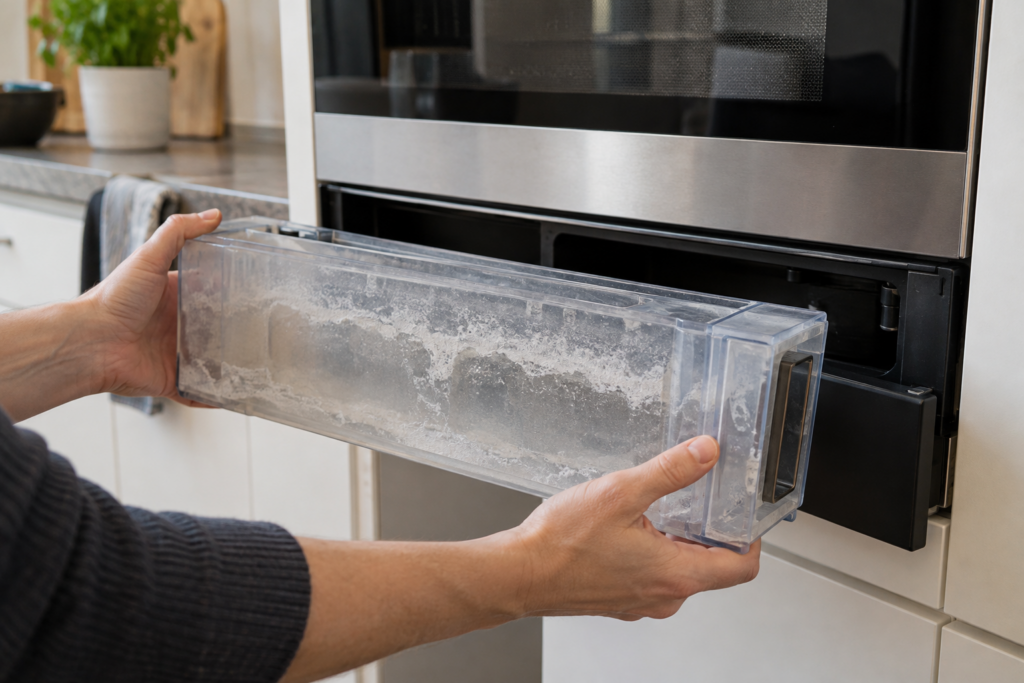
- Look at the tank before you start, and note any heavy scale, discoloration or floating particles.
- Rinse and refill with fresh water afterward, and run a short steam cycle to confirm normal output.
What Water Should You Use in a Steam Oven?
Fresh cold tap water or filtered water, refilled regularly. Switching to filtered water after descaling significantly extends the interval before F31 returns, and it is the single best preventive step available. This site's F30 page also warns that distilled water can cause mineral sensor errors on some KOSC models, so do not assume purer is better.
- Fill fresh before each steam session and avoid reusing water left in the tank for more than 24 hours.
- Use filtered water if your home has hard water, since hardness is what builds the scale.
- Inspect the tank for scale or particles every time you refill, and clean it before it builds up.
A Routine That Prevents Most Problems
Most steam oven faults trace back to water, so the routine is mostly about water. It takes a minute per session and avoids nearly every code on this page.
- Empty and refill the tank instead of topping it up, so the water is never stale.
- Look at the tank when you refill it, and clean off any film or scale before it hardens.
- Seat the tank until it clicks, every time, because a tank that is nearly in reads as empty.
- Run the descaling program on the schedule in the manual, and sooner in a hard-water home.
- Do not skip filtered water if your supply is hard, since it is what lengthens the interval.
The manual's schedule is the one to follow, and this guide cannot replace it. What it adds is the early signal, the fading steam, that tells you the schedule is not keeping up with your water.
When Descaling Does Not Help
If F31 persists after a completed descaling cycle, the sensor or the generator's heating element has failed, and descaling will not repair either. Stop using steam modes and call for service. Water leaking from the bottom of the oven during or after a steam cycle is a separate warning, and it should end steam use immediately.
- F31 after a full descale: the NTC sensor or thermostat has failed, or the heating element is heating unevenly.
- Water on the floor or inside the cavity bottom: stop steam use and have the tank and generator seals checked.
- F30 with a full, seated tank: the level sensor has failed.
In every case the conventional modes stay available while the steam side waits for service, so the oven is not out of action. Our KitchenAid oven F30 and KitchenAid oven F31 pages cover the safe checks for each code, and our KitchenAid range and oven maintenance guide covers the rest of the oven's care.
It also pays to note how the oven behaves when scale is building. A steam cycle that takes longer to produce visible steam, or a cavity that stays drier than usual, is a quieter signal than any code. Keeping a short log helps. Note the date of each descaling cycle and whether steam output changed afterward, because over a few cycles you will learn how quickly your water builds scale and can set your own interval with confidence.
When to Call a Technician
Descaling, refilling and reseating the tank are homeowner tasks. Sensor, element and seal faults inside the steam generator are not. Our KitchenAid oven repair service handles KOSC steam ovens and tests the generator on site.
A diagnostic visit starts from $95, and the final price is confirmed after the on-site diagnosis, with a written estimate before work begins. Book a visit or send us the model number and which code is showing, and we will tell you what to try first.