 Daniel Mitchell
Key Takeaways
- A 2001 CPSC notice covers Whirlpool, KitchenAid and Kenmore over-the-range microwave-hood combinations sold January 1998 to September 2001.
- The 2001 serial numbers begin with XC, and the notice excludes countertop microwaves.
- A separate 2016 notice names Whirlpool-brand units only, not KitchenAid; a KitchenAid unit is matched against the 2001 notice.
- Read the model and serial from the plate inside the door by flashlight, and photograph it.
- If your unit matches, stop using it, unplug it and contact the manufacturer for the remedy.
The Bottom Line
Check your microwave's serial prefix and model against the CPSC records and the manufacturer lookup. On a match, unplug it and follow the remedy; on a non-match, an old microwave that smells or sparks still needs service.
Over-the-range microwaves are one of the appliances people most often search a recall for, partly because they are mounted above a cooktop and partly because the model and serial plate is hard to read. If you own a KitchenAid microwave hood combination, the useful facts are in two federal notices, and they are not about the same machines. This guide sets out what the Consumer Product Safety Commission records say, how to read your own plate and what to do on a match. Every recall fact here comes from cpsc.gov records, not from this site's other pages.
| CPSC notice | Brands named | Hazard | How to match it | Remedy stated |
|---|---|---|---|---|
| 02-018, October 2001 | Whirlpool, KitchenAid and Kenmore over-the-range units, about 1.8 million, sold January 1998 to September 2001 | Can overheat and catch fire | Serial numbers beginning XC; open the door to read them | Stop using, unplug, free repair |
| 16-253, August 2016 | Whirlpool brand only, about 15,200 | Internal arcing can ignite a plastic part | Listed models and serial range inside the unit | Stop using, unplug, free replacement |
Is There a KitchenAid Microwave Hood Combination Recall?
Yes, from 2001, and it covers units sold between January 1998 and September 2001. The CPSC record describes microwave oven and exhaust fan hood combination units that install above ranges and were sold under the Whirlpool, KitchenAid and Kenmore brand names, about 1.8 million in all, with serial numbers that begin with XC. It states that countertop microwaves are not included.
The hazard it names is overheating and fire, and the notice reports seven fires involving these units that caused extensive property damage, with no injuries. The remedy was to stop using the unit, unplug it and obtain a free repair from the manufacturer.
- Brand names covered — Whirlpool, KitchenAid and Kenmore, with Whirlpool Corp. named as the company in the notice.
- Product covered — over-the-range combinations only, not countertop microwaves.
- Serial clue — serial numbers starting with XC, read from the plate inside the door.
The 2016 notice is a different campaign. It covers Whirlpool-brand microwave hood combinations, with listed WMH-prefix models and a stated serial range, and the CPSC product description names the Whirlpool brand only; KitchenAid is not named in it. A KitchenAid unit is therefore matched against the 2001 notice, and the CPSC database and the manufacturer lookup are the final word on any specific model and serial.
How Do You Find the Model and Serial Number on an Over-the-Range Microwave?
Open the door and look at the frame. The 2001 notice says to open the door to locate the serial and model numbers, and the 2016 notice puts the plate inside the unit above the oven cavity on the left-hand side. Use a flashlight, and photograph the plate rather than copying it by hand, because ones, sevens and the letter I are easy to confuse.
- Stop the oven and open the door fully — the plate is on the frame, not on the outside of the cabinet.
- Photograph the model and serial together — including every trailing letter and digit.
- Check the serial prefix — a serial beginning XC is the clue for the 2001 notice.
- Search the CPSC database and the manufacturer's recall lookup — they are updated separately.
- Keep the photo — with the purchase receipt, in a folder you will find again.
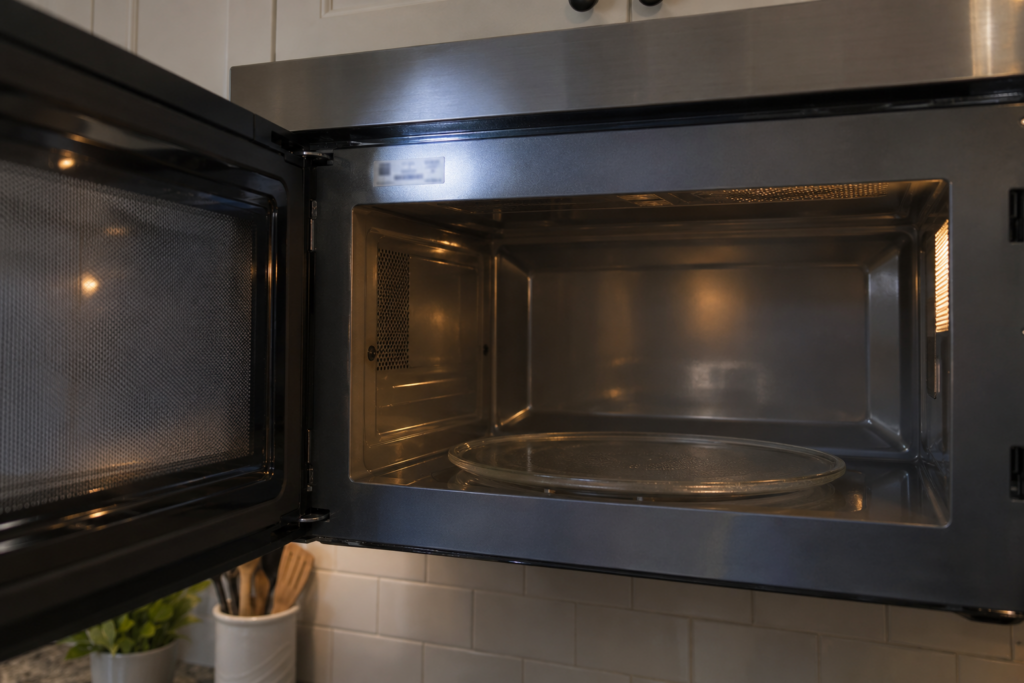
Our KitchenAid microwave high-voltage safety guide explains why you should not open the outer cabinet to look: the high-voltage parts hold a charge. Read the plate through the door opening only.
The Hazards Behind Each Notice
The incident reports are small next to the number of units sold, which is typical for a recall: it is issued on the risk of fire, not on a flood of events. The counts below are as the notices state them.
- 2001 — seven reports of fires involving the combinations, with extensive property damage and no injuries.
- 2016 — five reports, including one home fire, two fires involving the surrounding cabinets, one report of smoke and one of a burning odor.
A low count is not a reason to ignore a match. Both notices describe a defect that can start a fire, and both ask owners to stop using the unit and unplug it.
What Should You Do If Your Microwave Matches?
Follow the remedy in the notice: stop using it, unplug it and contact the manufacturer. The 2001 notice told owners to disconnect the unit by unplugging it and to call the manufacturer for a free repair, and the 2016 notice told owners to unplug the unit and contact the manufacturer for a free replacement. Neither suggested a repair by anyone else.
- Unplug it or switch off its breaker — an over-the-range unit may be plugged in behind a cabinet, so the breaker is often the safer route.
- Do not repair it yourself — a recall remedy is arranged by the manufacturer and your own work can complicate it.
- Do not let a third party repair it first — that includes us.
- Keep the paperwork — keep it once the remedy is complete.
Is a Microwave Fault the Same as a Recall?
No. A recall applies to a defect in a production run, while a fault is a worn or failed part in one oven. A microwave showing a door switch fault or a keypad code needs service, not a recall remedy, and the two go through different channels. Our microwave safety guide covers the faults that matter for safety, and our microwave F5 page covers a door switch fault.
It is also worth separating this recall from others with the same name on the same brand. The 2019 recall of glass cooktops with touch controls named KitchenAid among its brands, but it concerns cooktops, not microwaves, so a microwave owner does not need to match it.
If you cannot read the plate. On an over-the-range unit the plate can be hard to see behind the door frame, and a faded or painted-over plate cannot be matched at all. Photograph whatever is legible, and do not guess at characters; a wrong digit gives a false answer in both directions. If no plate can be found, treat the unit as unverified and have it inspected rather than assuming it is safe.
Registration. Registering the microwave with the manufacturer turns a one-off search into a notice that reaches you if a campaign is announced later. Have the model and serial you just photographed ready when you do.
When the Microwave Is Simply Old
A unit sold in the 2001 window is now about twenty-five years old or more, which is far beyond the life most owners expect. Even without a recall, an old over-the-range microwave that smells of burning, sparks or runs hot is a reason to stop using it. Our how long do KitchenAid microwaves last guide covers the lifespan, and the KitchenAid microwave repair or replace guide helps you decide what to do with an older unit.
The microwave repair page lists what a visit covers. Book a visit or send us the model plate photo and we can tell you what to check next. Recall remedies themselves come from the manufacturer, not from us.