 Daniel Mitchell
Key Takeaways
- These dishwashers use two separate code systems: letter-and-number pairs such as F9 E1, and two-digit pairs such as 8-1. A code from one list has no meaning in the other.
- Drain faults are the most common call — 8-1, F9 E1, 6-2 and F8 E1 all sit on the water-out side, and the sump filter explains a large share of them.
- Fill faults (6-1, F6 E1) usually start at the supply valve or the inlet screen rather than at the machine.
- Heat and thermistor codes are told apart by cycle timing: an element fault leaves timings normal, a sensor fault makes them erratic.
- Write the code down before clearing it — many models reset to a blank display and leave a technician with no evidence.
The Bottom Line
Identify which code system your machine uses before looking anything up, then group the code by function: water in, water out, heat, or control. That narrows a dishwasher fault to one circuit before anyone picks up a screwdriver.
KitchenAid dishwasher error codes come in two shapes, and that is the first thing to sort out. Some machines report faults as a letter-and-number pair like F9 E1. Others blink a simple two-digit pair like 8-1. Same manufacturer, same faults, different control generations — and a code from one system means nothing in the other. Once you know which list you are reading, the codes are unusually honest about what is wrong.
| Code | What it means | Part of the machine |
|---|---|---|
| 1-1 | Control board memory fail | Electronic control |
| 2-1 | Thermistor fault | Temperature sensing |
| 4-1 | Heating element | Heat and dry |
| 5-1 | Door switch failure | Door and latch |
| 6-1 / F6 E1 | Water inlet valve fail / no water fill | Water in |
| 6-2 / F8 E1 | Overflow float / overflow flood detected | Leak protection |
| 7-1 | Diverter motor failure | Spray arms |
| 8-1 / F9 E1 | Drain pump failure / drain timeout | Water out |
| F2 E2 | Keypad shorted key | Control panel |
| F3 E1 | Wash thermistor out of range | Temperature sensing |
Two Numbering Systems, One Machine
The F-and-E codes are read straight off a display or a blinking indicator sequence on models built around the newer control platform. The two-digit codes belong to the earlier generation and are usually delivered as flashes of a status light rather than as text. Neither system is a subset of the other, so the honest first step is to look at what your machine is actually showing rather than hunting for your number in a combined list.
Where the two systems describe the same failure, this site keeps separate pages for each, because the diagnostic detail differs. A drain failure reported as 8-1 is the pump itself; reported as F9 E1 it is a drain timeout, meaning the control gave the pump a window to empty the tub and the water was still there at the end of it. Related, not identical.
The Water-In Codes
Two codes cover the fill side, and both point at the same short list of suspects before anyone opens the machine.
- Check the supply first. The saddle valve or shutoff under the sink gets closed during other plumbing work more often than anyone admits.
- Look at the inlet screen. Sediment collects at the valve inlet and starves the fill without failing anything.
- Listen during the fill. A valve that hums but passes nothing is failing; a valve that is silent is not being energized.
- Do not keep restarting. Repeated dry cycles put the heating element at risk on models that heat during wash.
The site's page for code 6-1 covers the valve itself, and F6 E1 covers the no-fill condition as the control sees it. If the tub is dry at the end of a cycle and the machine ran anyway, treat it as urgent regardless of which number appeared.
The Water-Out Codes
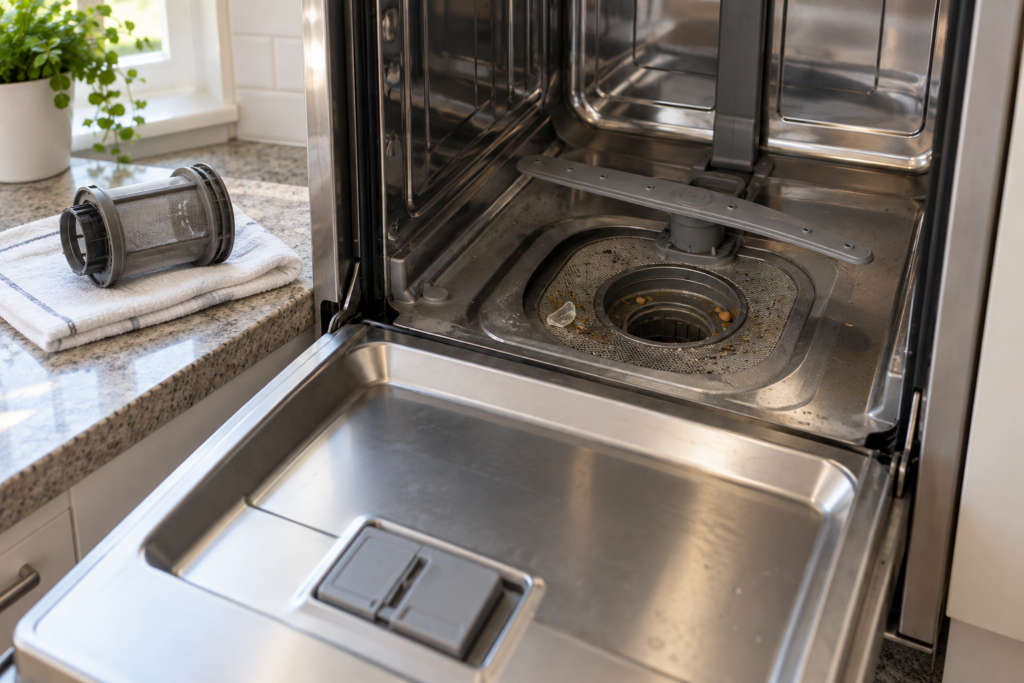
Drain faults are the most common service call on any dishwasher, and on these machines they arrive as 8-1, F9 E1, 6-2 or F8 E1 depending on generation and on whether the control decided the problem was a failure to empty or an actual overflow. The last two are the ones to respect: an overflow flood detection means the float has been lifted and the machine has stopped itself to avoid putting water on the floor.
Before any of these becomes a repair, the filter and sump deserve a look. Glass fragments, fruit stickers and seeds collect in the sump and under the filter, and they block the pump inlet long before the pump itself is worn. Our guide on a KitchenAid dishwasher that will not drain covers the sequence, including the air gap and the disposer knockout plug that catch out a surprising number of new installations.
Heat and Sensor Codes
Codes 4-1, 2-1 and F3 E1 all live in the heat-and-temperature part of the machine. A heating element fault shows up as dishes that come out clean but cold and wet. A thermistor fault is subtler: the control is still heating, but it no longer trusts what the sensor is telling it, so it either cuts cycles short or extends them indefinitely.
The distinguishing question is whether the cycle time behaves normally. An element failure leaves timings intact and the dishes cool. A sensor fault makes the machine act indecisive — cycles that run far longer than the display promised, or a heat-dry stage that never seems to start. Both are worth diagnosing rather than living with, because a machine that cannot measure its own water temperature is not sanitizing anything reliably.
Control, Door and Spray Codes
The remaining four codes cluster around the parts that tell the machine what to do. Code 1-1 is a control board memory failure, the most serious entry on the list. Code 5-1 is a door switch failure — the machine believes the door is open and refuses to start, or stops partway through. F2 E2 reports a shorted key in the control panel, which is why a machine can start cycles by itself or refuse to accept any button at all. Code 7-1 is the diverter motor, the part that routes water between the upper and lower spray arms.
A diverter fault is easy to misread as a wash quality problem. If the top rack comes out spotless and the bottom does not, or the other way around, the machine may be stuck feeding one arm. That is a mechanical fault with a code attached, not a loading mistake.
Reading the Code, Then Getting It Checked
Write the code down before clearing anything. Many of these machines will put themselves back to a ready state after a power cycle and hand you no evidence at all, and a technician arriving to a blank display starts from zero. If your model supports it, the service test walks the machine through fill, heat, wash and drain in sequence — our guide to the KitchenAid dishwasher diagnostic cycle covers what it proves and what it does not.
Fill, drain and heat faults are the bread and butter of dishwasher repair, and most are resolved in a single visit once the code has narrowed the field. Diagnostic visits start from $95, with the final price confirmed after the on-site diagnosis and a written estimate before any work begins. Book a visit with the code in hand and the technician arrives already knowing which half of the machine to open.