 Daniel Mitchell
Key Takeaways
- HI and LO report the cabinet itself, not a component — by the time either appears, the bottles have already been off temperature.
- FC is a fan circuit fault, and a blocked or dusty lower grille is the most common reason a built-in cellar loses cooling capacity.
- SE is the quiet one: with a sensor it cannot trust, the control regulates on assumptions and the display can be badly wrong.
- dr is usually a real open door — a bottle on the top rack or a fouled gasket is enough to defeat the seal.
- PF on a cellar is informational, but check the actual zone temperature after clearing it rather than trusting the display straight away.
The Bottom Line
Treat HI and LO as events that have already happened and move the bottles that matter. Treat FC and a dusty toe-kick grille as the maintenance task that prevents both, and treat SE as a reason to stop trusting the display until it is checked.
A wine cellar is the quietest appliance in the house until it is not. It has no cycles to interrupt and nothing to open and close, so the only way it can tell you something is wrong is a short code on the front panel — and by the time it does, the cabinet has usually been drifting off temperature for a while. KitchenAid wine cooler error codes are a small list, which makes them easy to learn before you need them.
| Code | What it means | How urgent |
|---|---|---|
| HI | Zone temperature high | Act now — the wine is at risk |
| LO | Zone temperature low | Act now — freezing risk |
| FC | Fan circuit fault | Soon — cooling is compromised |
| SE | Sensor error | Soon — the cabinet is flying blind |
| dr | Door left open | Close the door and check the seal |
| PF | Power failure | Clear it, then check the zone temperature |
HI and LO Are Not Warnings, They Are Results
The two temperature codes are different in kind from the rest. FC and SE describe a component; HI and LO describe the cabinet itself, which means the condition they report has already happened to the bottles inside. A zone reading high is not a prediction that cooling might fail — it is the cabinet stating that it is warmer than the set point right now.
That changes the response. With a dishwasher code you have the luxury of diagnosing at leisure. With HI on a dual-zone cellar, the useful move in the first ten minutes is to establish how long it has been that way, and whether the other zone is still holding. Dual-zone cabinets share a compressor but manage zones separately, so one zone holding while the other drifts is informative — it points at the damper, the zone fan or the sensor rather than the sealed system.
FC, and Why Wine Cellars Die of Dust
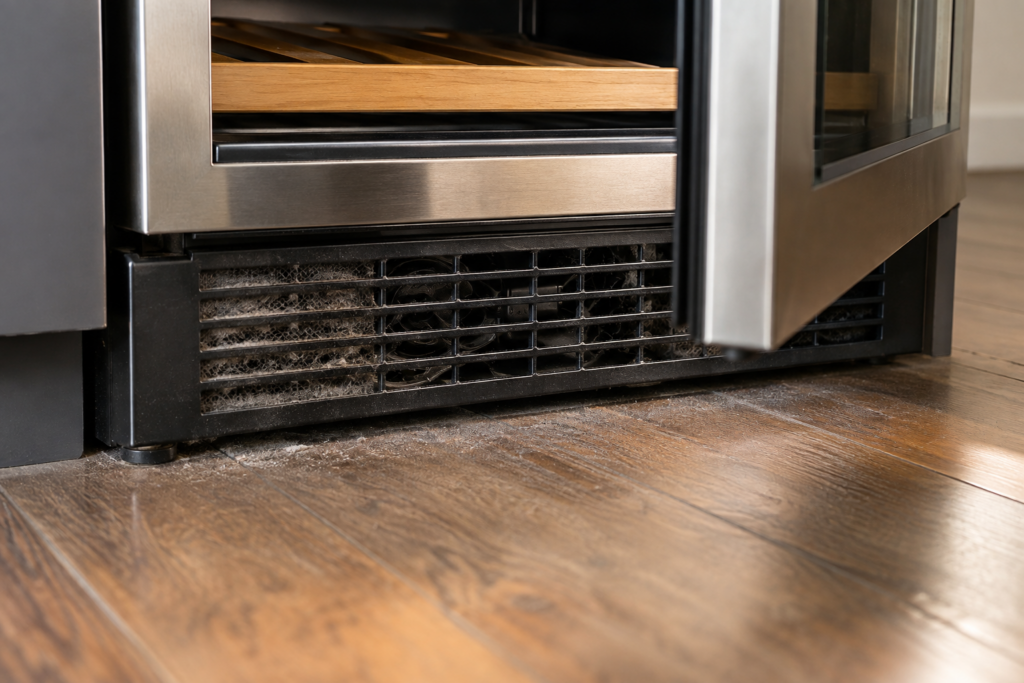
An FC code is a fan circuit fault, and the fan is the part of a wine cellar most likely to be quietly compromised long before it fails outright. Built-in cabinets breathe through a grille at the bottom of the door or the toe kick, and that grille sits at floor level in a kitchen.
- Vacuum the grille every few months. It is the single maintenance task that matters most on a built-in unit.
- Do not block the toe kick. A basket, a rug edge or a pet bed against the grille is enough to change the airflow.
- Listen for the fan cycling. A cabinet that has gone silent apart from the compressor is worth investigating.
- Check clearance above. Units installed under a counter need the gap the installation called for, not the gap that fit.
Airflow problems and temperature codes travel together. A cellar that starts showing HI on warm afternoons and recovers overnight is usually telling you about its cooling capacity and its ventilation rather than about a failed component.
SE and dr: One Serious, One Usually Not
SE is a sensor error, and it deserves more respect than its quiet presentation suggests. The control regulates by reading temperature; a sensor it cannot trust leaves it running the compressor on assumptions. A cabinet with an SE code may look fine on the display and be nowhere near the temperature it claims, which is exactly the failure mode that ruins a collection without anyone noticing.
The other half of the pair is less alarming. The dr code is the opposite of SE: a door left open, and nine times out of ten it is literally that. Glass wine cellar doors are heavy and close against a magnetic seal that a single misaligned bottle can defeat. Check the top rack, check that no label or cork is fouling the gasket, and clean the seal with warm water. A door that reports open while firmly closed is a switch or a hinge alignment problem, and it is worth fixing quickly because the cabinet will run continuously while it believes the door is ajar.
PF Is Housekeeping Here Too
Like the rest of the range, a wine cellar shows PF after a supply interruption and clears it with any button. The code itself is informational. What matters on this appliance is what happened during the outage, because a cellar that lost power for several hours may sit well above its set point with no indication once the code is cleared.
Check the actual zone temperature after clearing PF and give the cabinet an hour or two to recover before judging it. A PF that returns repeatedly without any outage is the same story here as everywhere else in the kitchen: check the plug and the outlet, and stop clearing it if it becomes a pattern.
What Is Worth a Service Call
Dust, door seals and blocked grilles are owner territory and account for a fair share of codes. Everything else on this list is not, because the sealed system, the zone damper and the control board all sit behind panels that are not designed to come off in a kitchen. The general habits in our refrigeration maintenance guide apply to a cellar as much as to a refrigerator.
Our wine cellar repair service covers the cooling circuit, the fans and the zone controls. Diagnostic visits start from $95, the final price is confirmed after the on-site diagnosis, and you get a written estimate before any work begins. If a zone is reading HI right now, move the bottles you care about somewhere cool first and book the visit second — the cabinet will keep for an afternoon, and some of what is inside will not.