 Daniel Mitchell
Key Takeaways
- Compressor work sits inside a sealed system, which is why it costs more than any other single repair on a KitchenAid refrigerator.
- Sealed system repairs start from $595 on this site, reflecting EPA-regulated refrigerant recovery and recharge, not a simple part swap.
- A clicking sound often means a failed start relay, not a dead compressor, and that repair starts from $175 — a fraction of the cost.
- A silent unit with no airflow often points at a fan motor, from $215, before the compressor itself is ever in question.
- The diagnostic visit, from $95, exists specifically to separate these three repairs before anyone pays for the most expensive one.
The Bottom Line
Do not authorize compressor-level work from a symptom alone. A $95 diagnostic separates a $175 relay, a $215 fan and a genuine $595 sealed-system repair, and that distinction is worth confirming before any refrigerant line is opened.
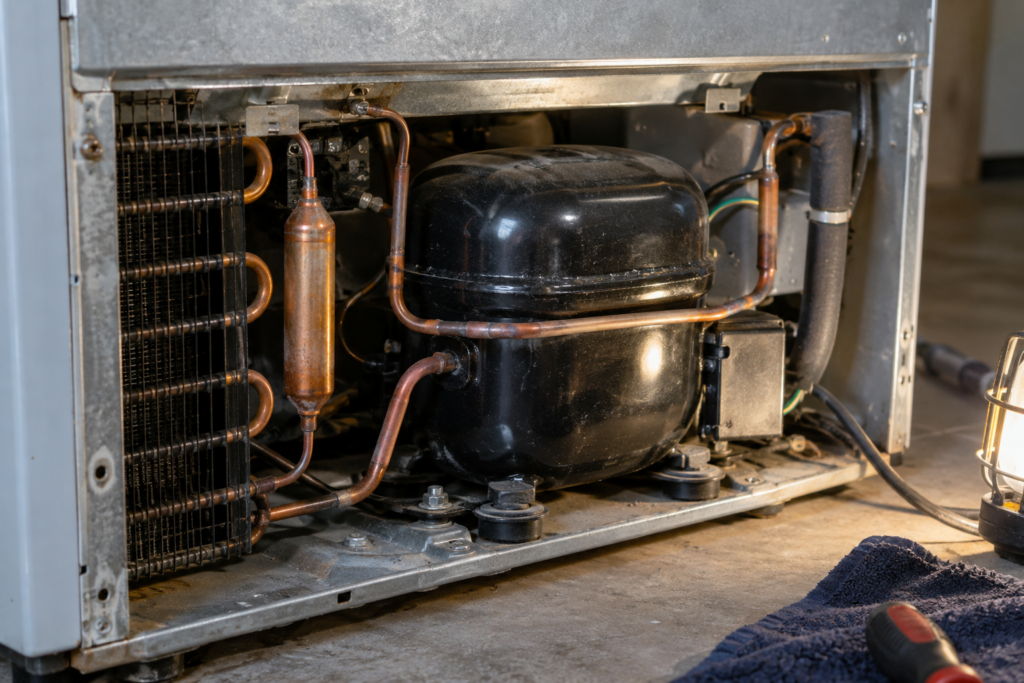
A KitchenAid refrigerator compressor sits inside a sealed system, and that single fact drives everything about the cost, the timeline and the decision that follows a compressor diagnosis. This is not a part an owner replaces or a shop swaps in twenty minutes — it means opening a system that is charged with refrigerant under federal handling rules, which is why kitchenaid refrigerator compressor replacement cost is one of the more expensive single-line repairs on this site.
| Repair | Typical starting price | What drives the cost |
|---|---|---|
| Diagnostic visit | from $95 | Confirms compressor vs. start relay vs. board |
| Start relay or capacitor | from $175 | Often mistaken for a dead compressor |
| Evaporator or condenser fan | from $215 | Airflow problem, not sealed-system |
| Sealed system repair | from $595 | Refrigerant recovery, EPA certification, labor |
Why Does Compressor Work Cost So Much More Than Other Repairs?
It costs more because the job is not just swapping a part — it is recovering refrigerant under EPA rules, brazing a sealed system back together, evacuating and recharging it, and confirming the repair holds under pressure before the appliance goes back into service. A technician cannot open that system casually the way they can open a control panel, and the certification and equipment behind that work are reflected in the price. Sealed system repairs on a KitchenAid refrigerator start from $595, which is the figure this site quotes for exactly this category of work.
Part of that cost is licensing rather than labor hours. Federal rules require anyone recovering refrigerant to hold EPA Section 608 certification, and the recovery equipment itself is a real capital cost a shop carries whether or not a given week brings many compressor jobs. That is different from most of the repairs elsewhere on this site, where the price mostly reflects the part and the time to reach it, and it is worth understanding why a compressor repair does not compare cleanly to, say, an ice maker module or a control board swap.
That number sits close to what a mid-range replacement refrigerator costs, and that overlap is not an accident — it is the reason this repair gets weighed against replacement more often than a filter or a fan does.
Is It Always the Compressor When Cooling Fails?
No, and this is the single most useful thing to check before paying for compressor-level work. A refrigerator that hums, runs constantly and still will not get cold shows exactly the same symptom whether the compressor has failed, the start relay feeding it has failed, or a condenser fan cannot move air across the coils. Two of those three are inexpensive fixes.
- Listen for a clicking sound every few minutes. A compressor trying and failing to start often clicks rather than staying silent — that points at the relay, not the compressor itself.
- Check whether the compressor is hot to the touch. An overheating compressor that keeps tripping its own protector is a different repair than one that never starts at all.
- Listen for airflow. No fan noise at all points at a fan motor, which starts from $215 — a fraction of sealed-system cost.
- Vacuum the condenser coils first. Dust-choked coils make a healthy compressor work harder and can mimic early compressor failure.
- Check that nothing blocks airflow around the unit. A refrigerator pushed flush against a cabinet on all sides fights the same battle a dirty coil does.
- Note whether the fault is constant or intermittent. A compressor that runs fine for hours and then cuts out points at a thermal protector, not necessarily a dead unit.
This is exactly why the diagnostic visit exists as its own line item at from $95: it separates a $175 relay from a $595 sealed-system job before either one is ordered.
A technician confirms which of the three it is with a meter and a gauge set, not by guessing from the sound alone. A start relay is tested by bypassing it briefly to see whether the compressor starts cleanly on its own; a fan is confirmed by checking for voltage at the motor while it sits silent; and only once both of those are ruled out does the sealed system itself get pressure-tested. That order matters because it protects the homeowner from paying sealed-system prices for what turns out to be a fifteen-dollar part.
Is It Worth Paying for a Compressor Repair?
It depends on the age of the refrigerator and what else is showing wear, and this is a decision this guide can frame but not make for you — for the full picture on when a KitchenAid refrigerator stops being worth repairing at all, see our is it worth repairing a KitchenAid refrigerator guide, which this page treats as the parent question, and our KitchenAid refrigerator repair or replace guide, which covers the decision at the whole-appliance level rather than the compressor alone. On a refrigerator under five or six years old, sealed-system work is usually the right call: the cabinet, the shelving and the electronics have plenty of life left, and $595 buys years of continued use. On an older unit already showing an aging ice maker, worn gaskets or a compressor that has already been serviced once, the same $595 is worth measuring against a replacement.
There is also a practical timing question that gets overlooked: a refrigerator with a failing compressor does not fail cleanly. It often runs longer and longer cycles trying to reach temperature, which drives the electricity bill up for weeks before the unit finally stops cooling altogether. Watching for that pattern — a compressor that used to cycle on and off and now seems to run almost constantly — is a useful early warning that buys time to make the repair-or-replace decision calmly rather than with a refrigerator full of spoiling food forcing the timeline.
- Get the diagnostic done first so you are pricing the actual fault, not a guess.
- Ask what the technician found — clicking relay, hot compressor, or a genuinely dead one — and write it down.
- Weigh $595 against the refrigerator's age rather than against the original purchase price.
- Consider the food loss risk if the unit fails again mid-repair-decision; a full fridge and freezer is worth protecting quickly either way.
- Ask about the warranty on the repair itself. A sealed-system job at this price should come with a meaningful parts-and-labor guarantee.
- Compare against a same-capacity replacement price, not against a larger or smaller model that changes the comparison unfairly.
Getting a Straight Answer
Nobody should pay for sealed-system work without a diagnostic confirming that is actually the fault. Our KitchenAid refrigerator repair service starts every compressor call with exactly that check, using the same $95 diagnostic that separates a relay from a compressor before any refrigerant line is touched. Full cost context for the whole appliance, not just the sealed system, is in our KitchenAid refrigerator repair costs guide.
The final price on any sealed-system job is confirmed after the on-site diagnosis, and a written estimate comes before any work begins — there is no surprise invoice on a job this size. Insurance and home-warranty coverage, where it applies, is worth asking about before the visit rather than after, since sealed-system work is exactly the category many warranty plans are written to cover. Book a diagnostic visit or describe what the refrigerator is doing and we will tell you which of the four repairs above you are actually facing.