 Daniel Mitchell
Key Takeaways
- A main control board replacement on a KitchenAid wall oven starts from $320; a combination oven board from $395.
- F1 E0, a memory failure on the main board, is the code that most often ends in a board replacement.
- F6 E0 and F2 E0 can have cheaper causes, a ribbon cable or a damp keypad, so rule those out first.
- A five-minute breaker reset clears transient faults; a code that returns immediately is a hardware fault.
- On a premium built-in oven the board is almost always worth replacing within the first 15 years.
The Bottom Line
Expect a main control board replacement to start from $320, and ask for the ribbon cable and keypad to be tested before the board is ordered. The final price comes after diagnosis, with a written estimate before work.
The control board is the most expensive common repair on a KitchenAid wall oven, and it is also the part most often blamed before anything has been tested. Three or four different codes sit close to it, and several of them have cheaper causes: a loose ribbon cable, a damp keypad, a sensor that has drifted. This guide sets out what a KitchenAid oven control board replacement costs on a wall oven, which codes really point at the board, and what to rule out so you do not pay for the wrong part.
| Repair | Starting cost | Related code |
|---|---|---|
| Temperature sensor (thermistor) | from $175 | F3 E0 |
| Door lock motor | from $245 | F5 E1 |
| Main control board | from $320 | F1 E0 |
| Combination oven control board | from $395 | Microwave-oven models |
| Ribbon cable or keypad | Quoted after diagnosis | F6 E0, F2 E0 |
How Much Does a KitchenAid Oven Control Board Replacement Cost?
A KitchenAid oven control board replacement starts from $320 for the main board of a wall oven, including labor, according to this site's wall oven cost guide. On a combination microwave-oven unit the control board starts from $395, because the added microwave control complexity makes the board more expensive. Those are starting prices: the final cost is confirmed after the technician completes an on-site diagnosis, and you should receive a written estimate before any work begins.
It helps to see that number next to its neighbors. A thermistor starts from $175 and a door lock motor from $245, so the board is the biggest of the common repairs. It is still modest against the cost of a new built-in oven, which the same guide puts from $2,500 for a single unit, from $4,000 for a double and from $5,000 for a combination oven.
Which Codes Point at the Control Board?
A handful, and only some of them mean the board itself has failed. The oven F1 E0 page describes an EEPROM checksum failure on the main board, the memory chip that stores firmware, temperature calibration and user preferences. The board cannot verify its stored data, so the oven is locked out. A five-minute breaker reset clears it temporarily, and if the chip has truly failed the code returns within one or two uses.
- F1 E0 — memory failure on the main board; this is the code that most often ends in a board replacement.
- F6 E0 — the display board and the main board have lost their data link; a damaged ribbon cable is a cheaper cause than a board.
- F7 E1 — the relay that supplies the lower bake element has failed, which is a relay on the board and a safety issue.
- F2 E0 — a key the control believes is held down; moisture or a damaged membrane is the usual reason, not the board.
Our KitchenAid oven error codes directory lists every code and what it means.
What to Rule Out Before Paying for a Board
Start with the cheap explanations, and ask the technician to test them before ordering. The pattern on the code pages is consistent: a transient fault clears with a reset, a hardware fault does not, and the cause of the second is not always the board.
- Try a five-minute breaker reset — it clears transient faults, and one clean bake afterward suggests a power event rather than a failed chip.
- Look at the code history — a code that returns immediately after a reset is a hardware fault; one that stays away is not.
- Ask about the ribbon cable — F6 E0 returns at once if the cable is damaged or a board has failed, and the cable is the cheaper of the two.
- Clean and dry the keypad — for F2 E0, moisture is the common cause and cleaning may resolve it for good.
Why Oven Control Boards Fail
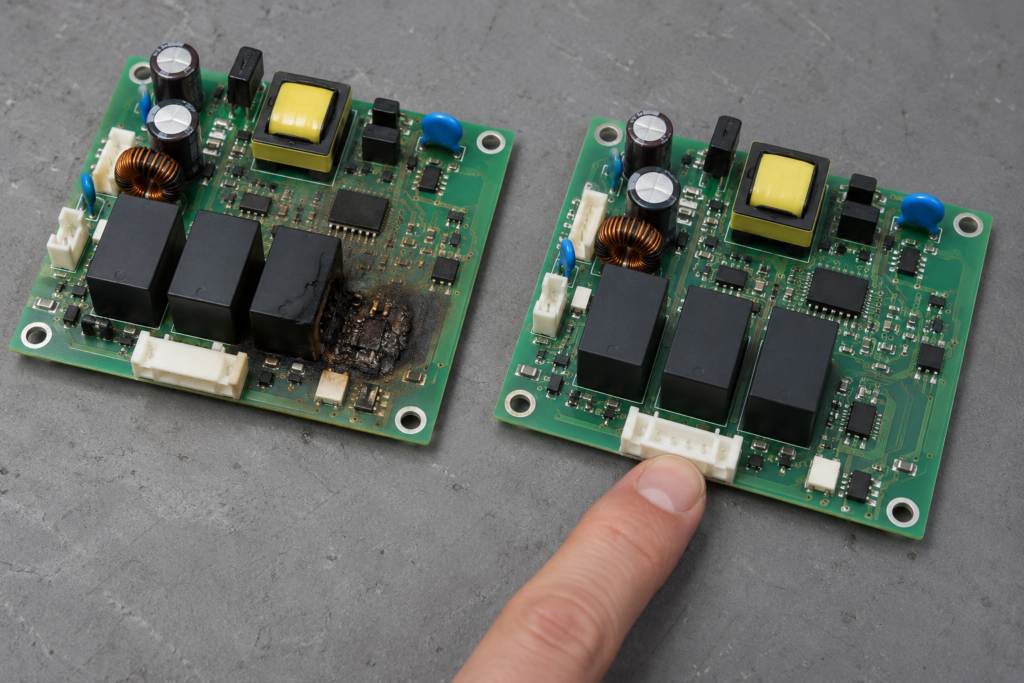
The F1 E0 page names three causes, and they explain why prevention is partly in your hands. The memory chip can wear out after years of thermal cycling inside the oven. A power surge during a storm or utility outage can write invalid data to it, so the checksum fails on every boot after that. And a connector that is not fully seated can cause intermittent errors that the board logs as a memory fault.
- Heat cycling — normal wear over years, and the one nothing prevents.
- Power surges — the cause you can reduce; our surge protection notice covers whole-house and point-of-use options.
- A loose connector — the cheapest cause, and the reason the visit should include a look at the harness.
The symptoms are consistent too. An oven that refuses to start, resets its settings after every power cycle or beeps with no input is showing the signs of a memory fault. When those signs appear, the sensible first question for a technician is whether the board has actually failed or only lost its data.
What Moves the Control Board Price
The oven's type and where it sits matter as much as the part. The site's cost guide covers KOSE, KODE, KOCE and KOSC models, and the combination and steam units have more components than a basic thermal wall oven.
- Single, double or combination — a double oven or a combination microwave-oven unit costs more to repair than a single oven.
- Built-in access — ovens installed in cabinetry need more labor to reach than a freestanding unit.
- Part complexity — a combination oven board starts higher than a standard one.
- Extra faults found on the visit — a failed sensor or latch motor discovered alongside the board changes the total.
Is a New Control Board Worth It on an Older Oven?
Usually yes, because the oven is expensive to replace. Our is it worth repairing a KitchenAid wall oven guide says wall ovens commonly last 14 to 18 years and are almost always worth repairing in their first 15, with repairs on older units judged against a lower cap. It also points out that a replacement with different cutout dimensions can need cabinet work, which tips many decisions toward repair.
The cases for stopping are a very old oven with a board fault and other failures waiting behind it, or a combination unit whose board and microwave module are both suspect. In those cases, price the whole picture before you approve anything. The KitchenAid wall oven repair or replace guide has the framework.
Getting a Quote
Ask the technician to name the failed component and show the evidence, such as the code history and the test that confirmed it. The KitchenAid oven repair page lists what a visit covers, and our oven repair costs guide lists the other common prices. Book a visit or send us the model number and the code on the display.