 Daniel Mitchell
Key Takeaways
- KitchenAid exited the standalone washer market after 2012, so every washer still in service is a legacy KAWS, KAWE or KHWV unit.
- A lid switch repair starts from $165, a drain pump from $225 and a motor control board from $295.
- Control boards and some motor assemblies are increasingly hard to source, so availability should be confirmed before you approve a quote.
- SUD, LF and some F9 and F8 faults have no-cost causes a homeowner can rule out first.
- When the parts cost approaches the price of replacing the machine, the honest answer is not to repair it.
The Bottom Line
Rule out the free causes, confirm the part exists, and compare any control board or motor quote with the 50 percent rule before you approve it.
The KitchenAid washer repair cost picture has a wrinkle that most appliance cost guides never face: KitchenAid left the standalone washer market after 2012, so every machine still in service is a legacy unit. The KAWS and KAWE top-loaders and the KHWV front-loaders keep running in many homes, and what a repair costs depends as much on whether the part can be found as on what the part is.
| Repair | Code it usually answers | Starts from |
|---|---|---|
| Lid switch or door lock replacement | F5, lid switch or door lock fault | from $165 |
| Drain pump replacement | F9, drain pump fault | from $225 |
| Motor control board replacement | F7, motor drive fault | from $295 |
| Inlet valve or pressure sensor | LF long fill, F8 level sensor | Quoted after diagnosis |
How Much Does a KitchenAid Washer Repair Cost?
A KitchenAid washer repair starts from $165 for a lid switch replacement, from $225 for a drain pump and from $295 for a motor control board. Those are the starting figures for the three most common legacy repairs, and the final price is always confirmed after an on-site diagnosis, with a written estimate before any work begins.
The spread between them follows the parts. A lid switch is a small, inexpensive component that the machine is constantly asking to work. A drain pump is a motor and an impeller, and it fails often enough that parts are easy to find. A motor control board is an electronic module that is specific to the platform, and it is the repair most affected by the supply problem described below.
Why Are Legacy KitchenAid Washer Parts Harder to Find?
Because the washers were built on a shared platform and then discontinued, so parts now come from two places: cross-reference to the manufacturer's parts catalog where the numbers match, and specialty legacy-parts suppliers where they do not. Some components, particularly control boards and specific motor assemblies, are increasingly difficult to source, which is why availability is verified before a repair is quoted.
- Cross-referenced parts: switches, valves and pumps often share numbers with the platform's other washers.
- Specialty suppliers: the fallback for boards and motors, with less predictable stock.
- Availability check first: the estimate should confirm the part can actually be had before you approve the job.
That sequence matters for your decision. A price you cannot act on is not a price, and a good technician tells you when the part is not available instead of quoting it anyway.
Which KitchenAid Washer Faults Cost Almost Nothing to Fix?
Several codes have causes a homeowner can clear with no part at all, and it is worth ruling them out before any estimate. They are the reason a code on the display does not always mean a bill.
- SUD, too many suds: too much detergent, non-HE detergent in an HE washer, or a dirty dispenser.
- LF, long fill: a supply valve that is closed or partly closed, or a clogged hose inlet screen.
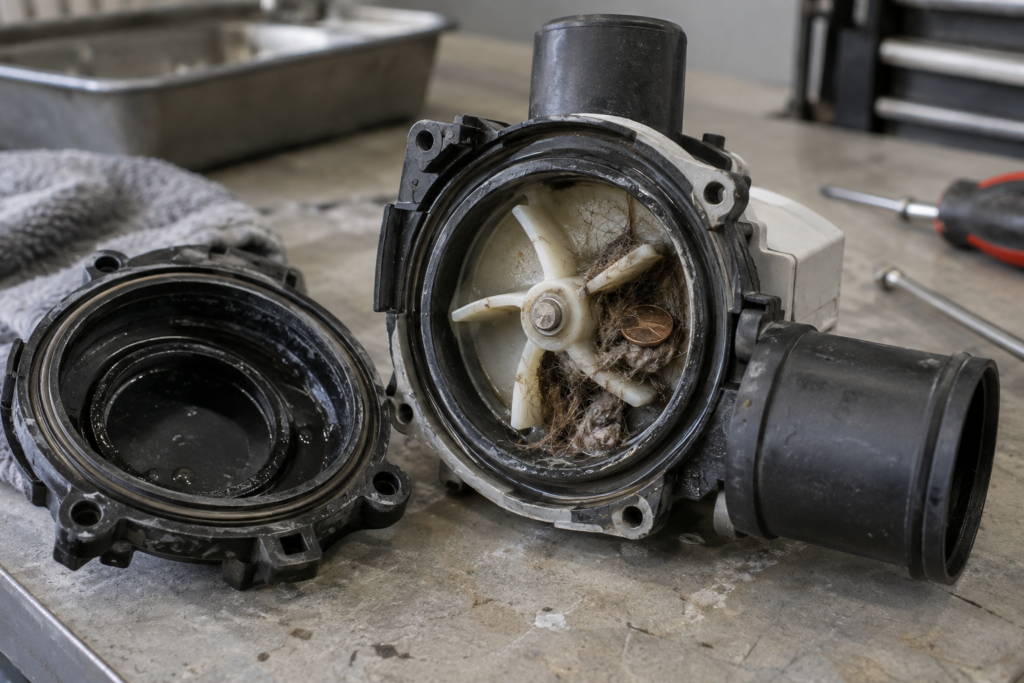
- F9, drain pump fault: a drain hose that is clogged or kinked, or debris blocking the pump impeller.
- F8, level sensor: a pressure sensor hose that is clogged or kinked, before the sensor itself is blamed.
Our code pages for SUD, LF and F9 list the safe checks. By contrast, F5 and F7 have only professional causes: a failed lid switch or lock mechanism, a broken harness, or a failed motor control board, drive motor or rotor position sensor.
What the Common Faults Look Like
The faults that bring legacy washers in follow a short list, and matching yours to it helps you read an estimate. Each one maps to a code on the display and to a starting price in the table above where one applies.
- The cycle will not start or stops mid-wash: the F5 lid switch or door lock fault.
- The drum will not spin or agitate: the F7 motor drive fault.
- Water will not drain and stands in the tub: the F9 drain fault.
- Slow or no fill during the wash: the LF long fill fault.
- The control panel is unresponsive: the F1 main control board fault, or a stuck key under F2.
The service visit itself follows a fixed order: document the fault codes and check the water supply and drain, run diagnostic mode, test the pump and motor individually, confirm the part is available, and give you the cost in writing. Each step before the estimate is there to stop you paying for the wrong part.
When Does a Legacy Washer Repair Stop Making Sense?
When the parts cost approaches the value of replacing the machine, which is the point at which an honest technician will tell you not to repair it. For a legacy washer that line arrives sooner than it would for a current model, because the replacement is a new machine with a new warranty and the old one has fewer years ahead of it.
- Cheap repair, common part: a lid switch or drain pump on a washer that is otherwise sound is usually worth doing.
- Control board or motor assembly: weigh the quote against the 50 percent rule, and confirm the part exists.
- More than one repair in a year: a pattern of unrelated faults suggests the machine is approaching the end of its life.
- A coupler failure on a direct-drive machine: a different case, covered in our KitchenAid washer motor coupler worth replacing guide.
What the Estimate Should Contain
Ask for four things in writing before you approve the work, because they are what separates a real estimate from a guess.
- The confirmed fault, found by running diagnostic mode and testing the pump and motor individually.
- The part and its availability, verified before the quote, with the source named.
- Parts and labor itemized, so you can compare it with the starting figures above.
- A plain statement on repair against replacement when the quote is high for the machine's age.
If a hose is involved, replace it while the machine is open. Our KitchenAid washer hose safety guide explains why an old hose is worth swapping at the same visit.
One last practical point is timing. On a legacy machine, a part that has to come from a specialty supplier can add days to the repair, so ask how long the part will take before you plan around the washer being back. If the answer is vague, treat that as information about how scarce the part is.
Getting an Estimate
Our KitchenAid washer repair service supports the legacy KAWS, KAWE and KHWV models and verifies parts before it quotes. A diagnostic visit starts from $95, and the final price is confirmed after the on-site diagnosis, with a written estimate before work begins. Book a visit or send us the model number and the code on the display, and we will tell you whether the part is available.