 Daniel Mitchell
Key Takeaways
- A dusty condenser coil behind the front grille is the cheapest cause of an HI alert, and a homeowner can clear it.
- Check that the door closes fully and the gasket seals all around, especially after loading bottles.
- Level the unit, keep it clear of cabinets and walls, and use the supplied shelving inserts to limit vibration.
- dr, PF and an occasional HI are notices or airflow symptoms; LO and persistent HI need a technician.
- Frost or condensation outside the cabinet, or a temperature that keeps climbing after cleaning, means stop and call.
The Bottom Line
Vacuum the condenser behind the grille regularly (your owner manual gives the interval), check the door seal when you load bottles, and keep the unit level and clear. Persistent HI after that is a service call.
A wine cooler does not usually fail in an obvious way. It slowly drifts a few degrees warm on hot afternoons, the compressor runs a little longer, and one day the display shows HI. The cause is more often a dusty grille or a door that is not quite closed than a failed part, which makes KitchenAid wine cooler maintenance an unusually good return for a few minutes of work. This guide covers what to clean, what to check and what the alerts are really telling you.
| Task | How often | What it prevents |
|---|---|---|
| Vacuum the condenser coil behind the front grille | Regularly, as your owner's manual advises, and whenever HI appears | Warm zones and a compressor running flat out |
| Check that the door closes fully and the gasket seals | Each time you load bottles | Warm air leaking in, a false cooling fault |
| Keep the lower grille and surrounding space clear | Ongoing | A condenser starved of air |
| Check the level and that nothing touches the cabinet | After any move or install | Vibration that disturbs the wine |
| Check the plug is fully seated | Once a year | Repeated PF alerts without any real outage |
What Should You Clean on a KitchenAid Wine Cooler?
The condenser coil, and almost nothing else. It sits behind a small grille at the base of the unit, and dust and lint there insulate the coil the way a blanket would, so the compressor works harder to reject the same heat. Our wine cooler HI page says a sizable share of HI alerts trace back to a door slightly ajar or a dusty condenser, and both are homeowner fixes.
- Unplug the wine cooler before touching the grille.
- Remove the front grille at the base of the unit.
- Vacuum the dust from the coil with a brush attachment, working gently along the fins.
- Replace the grille and restore power, then check the display after a few hours.
A blocked lower grille starves the condenser of air, so keep the space around it clear too. Do not use a hose or damp cloth on the coil, and do not bend the fins.
It helps to note the zone temperature before and after the clean. If the display drops back toward the setpoint within a few hours, you have found the cause and saved a service call. If it does not, you have ruled out the cheapest explanation and can describe the problem more precisely when you do call, which shortens the visit.
How Do You Check the Wine Cooler Door Seal?
Close the door and look and feel all the way around it. The gasket should meet the cabinet with no visible gap, and a bottle that sticks out a fraction too far can stop the door closing fully without you noticing. A gasket that no longer holds a firm seal lets warm air in continuously, which mimics a cooling failure, and a torn section leaks cold air into the room.
- Check the door when loading — the most common cause of a door sitting slightly ajar is a bottle in the way.
- Look for torn or flattened sections on the gasket, especially at the corners.
- Run a hand around the edge with the compressor running; you should not feel warm air.
The door reminder alert, dr, fires when the door has been open longer than the threshold, typically two or three minutes. It is a notice, not a fault.
Setup That Protects the Wine
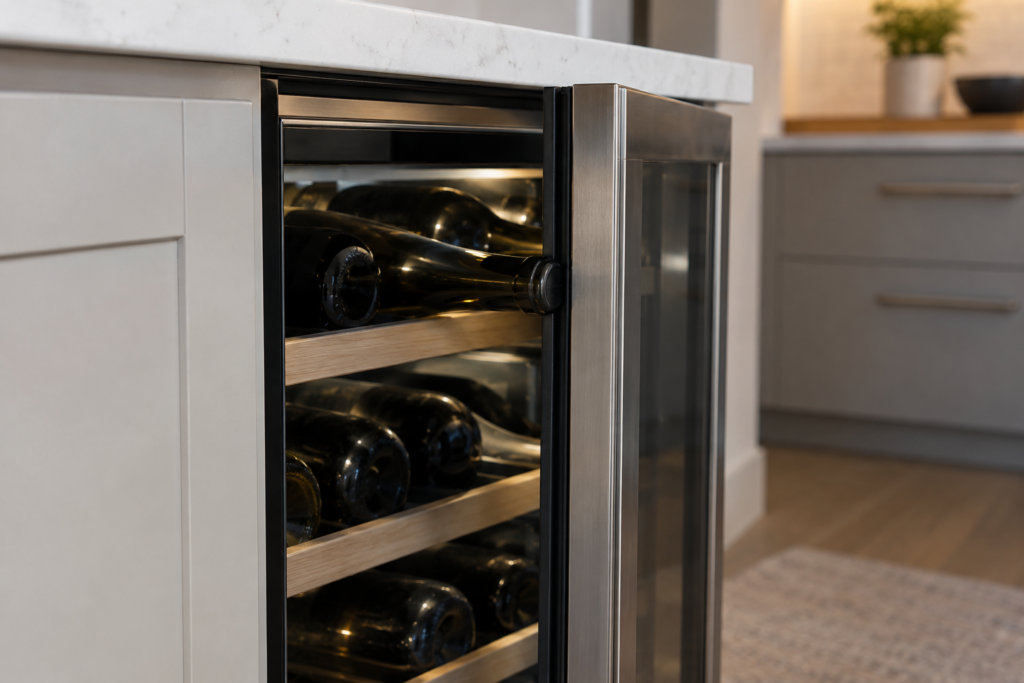
Placement matters more on a wine cooler than on most appliances, because vibration affects bottles over time. This site's notice on KitchenAid wine refrigerators says that vibration disturbs sediment and accelerates chemical reactions that degrade flavor, and that it matters most for long-term aging. The KUWR and KUWL models use low-vibration compressors, but the installation has to cooperate.
- Level the unit carefully using the adjustable feet.
- Keep it clear of adjacent cabinets and walls so nothing transmits vibration into the cabinet.
- Use the shelving inserts that came with it; they are designed to dampen vibration.
- Do not stack other appliances on top of it or push them against it.
Bottles visibly buzzing on the shelves, a compressor louder than usual, or a rattle inside the cabinet are signs to take seriously. Excessive vibration usually points to a compressor problem or a failed mounting, which is a service call rather than a maintenance job.
How Often Should a Wine Cooler Be Cleaned?
This site does not set a fixed interval, so check your owner's manual and use the symptom as the schedule. Look at the grille from time to time, and any time the zone temperature creeps above its setpoint. A household with pets or a dusty room will see the coil clog sooner than one without, and a unit tucked into a tight alcove with little airflow will run warmer sooner.
Reading the Alerts in Plain Terms
Most of the display messages are either reminders or symptoms of the same two problems, airflow and the door. Knowing which is which keeps you from calling for a fault that is not one. Our KitchenAid wine cooler error codes guide covers the full set.
- dr — the door has been open too long; close it.
- PF — power was lost; wine tolerates brief excursions, unlike frozen food, and the alert is informational.
- HI — a zone is 8 to 15 degrees F warmer than the setpoint; clean the condenser and check the door before anything else.
- LO — a zone is well below its setpoint and risks freezing wine; this one needs a technician.
- SE and FC — a zone sensor reading out of range, or the circulation fan not running at speed.
Wine is more forgiving than frozen food, but it is not indifferent. A brief warm spell during a power cut will not hurt a bottle, while weeks of a zone running well above its setpoint will. If a zone has been warm for a long time, move the bottles you care most about to a cooler spot while you sort out the cause, and check the corks for seepage before the next tasting.
When Maintenance Is Not Enough
Stop if the temperature keeps climbing after the condenser has been cleaned, or if you see condensation or frost on the outside of the cabinet. A slow refrigerant leak is the third cause on the HI page, and the cooling system is sealed, so that is not homeowner work. Our wine cellar repair page lists what a visit covers, and the wine cooler compressor repair or replace guide covers the bigger decision.
The final price is confirmed after on-site diagnosis, with a written estimate before any work begins. Book a visit or send us the model number and what the display shows. If the whole kitchen is due for a check, our seasonal maintenance checklist puts the tasks in one place.