 Daniel Mitchell
Key Takeaways
- A KitchenAid wine cooler has no compressor-specific code; HI and LO are temperature symptoms that can point at the compressor indirectly.
- FC, a fan circuit fault, produces a similar warm-cabinet symptom for a fraction of the cost, and it should be ruled out first.
- A confirmed diagnostic, from $95, is worth getting before ordering compressor-level repair on any HI or LO code.
- Freestanding and smaller wine coolers often cost less to replace outright than a full sealed-system repair costs.
- Built-in units matched to cabinetry openings are worth repairing more often than freestanding ones, since replacement is not a simple swap.
The Bottom Line
Do not repair a wine cooler compressor on a HI or LO code alone — rule out the fan and the sensor circuit first, and price replacement against repair before committing, especially on a smaller freestanding unit.
A KitchenAid wine cooler does not have a dedicated compressor fault code — the site's own error-code pages confirm that. What it has instead are two temperature alarms, HI and LO, that show up when the compressor can no longer hold the cabinet at its set point, plus a separate fan-circuit code, FC, that names a different and much cheaper part in the same cooling system. Telling these apart is the whole question behind kitchenaid wine cooler compressor repair or replace.
| Code | What it actually names | Compressor-related? |
|---|---|---|
| HI | Zone temperature high | Often, but not always |
| LO | Zone temperature low | Sometimes — can be a stuck thermostat |
| FC | Fan circuit fault | No — separate, cheaper part |
| SE | Sensor error | No — sensor circuit, not cooling |
Why Is There No Compressor Code on a KitchenAid Wine Cooler?
Because a compressor is a mechanical part, not a sensor, and this appliance's control board only reports what its sensors can measure directly — temperature and a handful of switches. A failing compressor never announces itself as "compressor" on the display. Instead it announces itself indirectly, through HI or LO, because the symptom the board can actually detect is that the cabinet has drifted away from its target temperature.
That indirection is exactly why this decision is harder than it looks for other appliances on this site. A dishwasher or an oven usually names its own failed part; a wine cooler's compressor hides behind a temperature reading, and ruling out the cheaper parts first is the only way to reach it honestly.
Should I Check the Fan Before Suspecting the Compressor?
Yes, every time. FC — a fan circuit fault — is a completely different and far less expensive repair than anything involving the compressor, and it can produce the exact same downstream symptom: a cabinet that runs warm because the cold air the compressor is producing never circulates. A dusty or seized evaporator fan starves the cabinet of airflow even while the compressor itself is working correctly.
- Listen for fan noise when the unit is running. Silence where there should be a soft hum points at FC, not the compressor.
- Feel for airflow at the vents inside the cabinet, if the model has them exposed.
- Check whether HI clears after cleaning the vents of dust — a blocked airflow path can produce HI on its own.
- Do not assume the compressor just because HI is showing; FC or a dirty condenser can produce it too.
- Check the door seal. A gasket that no longer holds a firm seal lets warm air in continuously, mimicking a cooling failure.
- Give the unit time after any door left open. A brief HI after a long browsing session at the door is not the same as a persistent one.
A dirty condenser deserves its own mention here, because it is the single cheapest cause of a HI code and the one most owners can rule out themselves before booking anything. The condenser coil on most wine coolers sits behind a small grille at the base of the unit, and dust buildup there insulates the coil exactly the way a blanket would, making the compressor work harder to reject the same amount of heat. A vacuum brush run along that grille twice a year, more often in a dusty basement or garage installation, prevents a meaningful share of the HI codes this guide is written to answer.
Placement matters just as much as cleaning. A wine cooler tucked into a tight cabinet opening with no clearance behind it fights the same battle a clogged condenser does, because the heat the compressor rejects has nowhere to go. Built-in units are designed with a specific ventilation path in mind, usually venting at the front through a lower grille, and blocking that path with stored items in the cabinet below produces the same warm-cabinet symptom as a genuine mechanical fault.
Is It Worth Fixing a Wine Cooler Compressor, or Better to Replace the Unit?
Once a diagnostic visit — starting from $95 — has actually confirmed the compressor and ruled out the fan and the sensor circuit, the repair-or-replace question on a wine cooler comes down to one thing that is different from a full-size refrigerator: many wine coolers, especially smaller under-counter and freestanding units, cost less to replace outright than a full sealed-system repair costs on a larger refrigerator. That math does not exist for every wine cooler — a large built-in dual-zone unit integrated into custom cabinetry is a different calculation than a freestanding countertop model — but it is worth doing before committing to a compressor repair.
- Get the diagnostic confirmed rather than guessing from HI or LO alone.
- Price the unit's replacement at its current size and capacity, not at what you originally paid.
- Weigh built-in versus freestanding. A built-in unit matched to cabinetry openings is worth repairing more often than a freestanding one is.
- Consider what is stored inside. A cabinet holding an expensive collection changes the urgency, even if it does not change the math.
- Ask whether the fault is isolated to one zone on a dual-zone unit before pricing a full compressor job.
- Check how the unit is installed — a custom cabinetry cutout narrows your replacement options and shifts the math toward repair.
Our KitchenAid wine cooler error codes guide covers the full code set, including FC and SE, in more depth than this page — read it first if you have not already narrowed the symptom down to HI or LO specifically. For the equivalent decision on a full-size refrigerator, where sealed-system pricing and the repair math work differently because the appliance itself costs more to replace, our KitchenAid refrigerator repair costs guide covers that larger appliance's own sealed-system pricing.
One more distinction worth making before any repair is authorized: a wine cooler that has simply drifted out of calibration, running a few degrees warmer or colder than its set point without ever showing HI or LO, is not a compressor question at all. That is usually a thermostat or sensor calibration issue, and it is worth ruling out with a straightforward temperature check against a separate thermometer before assuming the compressor is involved, since recalibration costs nothing like a sealed-system repair does.
Dual-zone units add one more wrinkle worth knowing about before assuming a whole-unit failure: each zone typically runs its own thermostat and, on some models, shares a single compressor between them through a set of dampers. A HI or LO code isolated to one zone while the other holds its temperature correctly points at that zone's damper or sensor rather than at the compressor itself, which is a meaningfully cheaper repair and worth ruling out before assuming the worst.
Getting a Confirmed Diagnosis
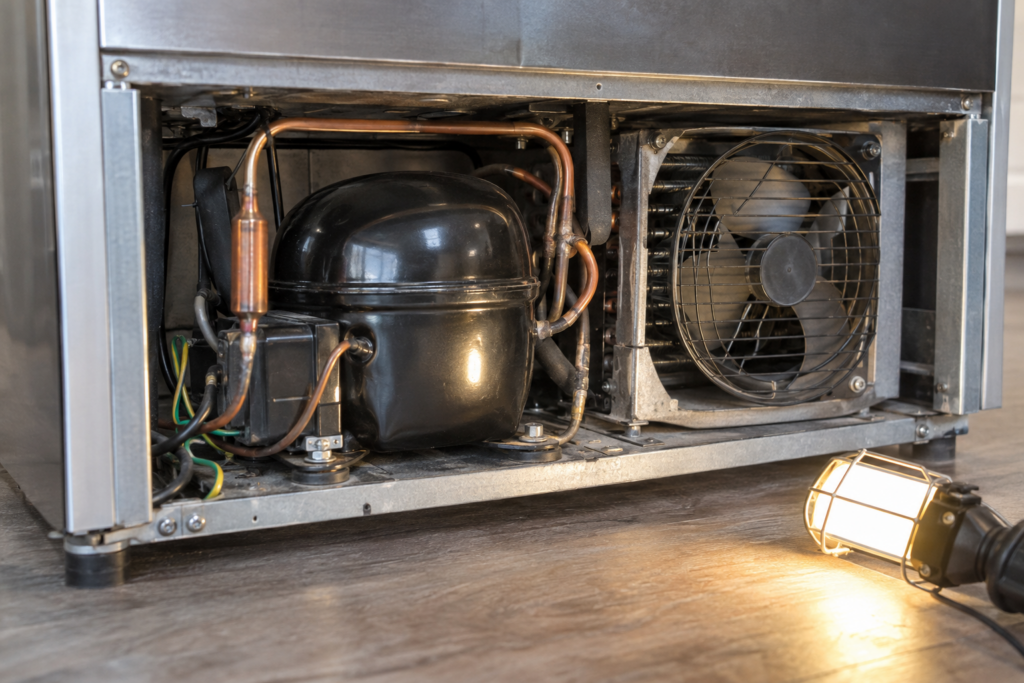
A wine cooler's cooling system is sealed in the same way a refrigerator's is, and opening it to test or replace a compressor is not homeowner work. Our KitchenAid wine cellar repair service starts with the same $95 diagnostic that separates a fan fault from a sensor fault from an actual compressor failure, before any refrigerant line is touched.
The final price on any compressor-level repair depends on the model and is confirmed after the on-site visit, with a written estimate before work begins. Our broader appliance diagnostics visit covers exactly this kind of ambiguous symptom when you are not yet certain which appliance or which part is at fault. Book a diagnostic or tell us whether you are seeing HI, LO or both and we will tell you which repair you are actually facing.