 Daniel Mitchell
Key Takeaways
- E1 means the inverter for that zone hit a protective current or thermal limit; heavy cast iron is the most common trigger.
- Try a different induction-rated pan, wait about fifteen minutes, and listen for the cooling fan before blaming the board.
- F9 E0, a failing cooling fan, is worth fixing first because it protects the board from heat.
- E1 on several zones, or at low power, points at the electronics and calls for service.
- Repair the generator board in the first 12 years; control board faults after 12 years approach replacement time.
The Bottom Line
Rule out the pan and the fan first. If E1 keeps returning with different pans, the generator board is the cost to weigh, and the cooktop age decides whether to repair or replace.
An induction cooktop zone that cuts out at high power and shows E1 is usually reacting to the pan, not announcing a dead cooktop. But when the same code keeps appearing with a pan that never gave trouble before, the suspect moves to the part that drives the zone, the inverter on the generator board, and that is the most expensive repair on a KitchenAid cooktop. Knowing how to tell the pan from the fan from the board decides whether you spend nothing, a little, or a lot.
| What you see | Most likely cause | Lean |
|---|---|---|
| E1 only at boost power with a heavy cast iron pan | Cookware that presents a very low load to the coil | No repair: change the pan |
| E1 returns with several pans, at lower power | Aged inverter components on the generator board | Repair or replace by age |
| E1 on more than one zone at once | Inverter fault or cooling problem | Stop and book service |
| F9 E0, no airflow from underneath | Cooling fan or its drive circuit | Fix the fan first; it protects the board |
| F5 E0, zone does not detect the pan | Pan detection circuit or incompatible cookware | Try an induction-rated pan, then diagnose |
What Does E1 Mean on a KitchenAid Induction Cooktop?
E1 means the inverter driving that zone has exceeded a protective current or thermal limit. Our cooktop E1 page explains that the inverter converts mains power into a high-frequency magnetic field that heats the pan, and that the load from the pan, combined with the inverter's condition, can push it past its limit. The code usually clears on its own once the inverter cools and a compatible load is detected.
It tends to be load-dependent: the zone simmers happily and trips within seconds when you ask for high heat. Other zones usually keep working, because E1 typically affects only one generator, and zones served by a different inverter run normally while the affected one is locked out.
- Zone cuts out during high-power cooking — it stops heating, shows E1 and refuses to restart until it has cooled.
- Runs normally at low power, trips at high power — a classic signature of an overload rather than a dead zone.
- The rest of the cooktop works — useful evidence that the problem is one inverter and not the whole unit.
Is It the Pan, the Fan or the Generator Board?
Work through them in that order, because each is cheaper than the next. Very heavy solid cast iron is the most common cause on the code page, since some pans present a load that the inverter was not designed to handle. Swap in a different induction-rated pan of similar size and retry the zone at boost.
- Change the pan — mid-weight carbon steel and multi-ply stainless with a thin ferrous base are usually well matched.
- Wait about fifteen minutes after E1 before retrying, since thermal protection holds off restart until the inverter cools.
- Listen for the cooling fan — with a burner on, you should hear a soft whir and feel gentle airflow at the underside slots.
- Note the pattern — one pan or all pans, one zone or several, boost only or all power levels.
If E1 appears on several zones together, or trips at low power where no overload should occur, stop using the cooktop and call for service. That pattern points away from cookware and toward the electronics.
Why the Cooling Fan Matters
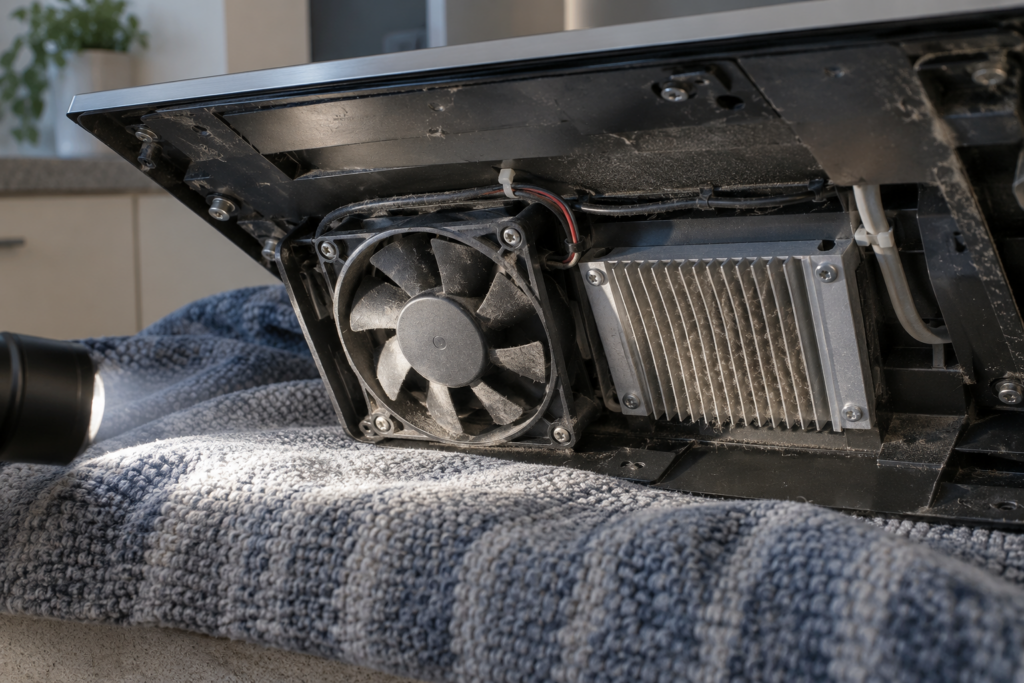
An inverter that cannot shed heat wears out faster, and the fan is what carries that heat away. The cooktop F9 E0 page describes the electronics cooling fan failing or running below its minimum speed, and warns that extended use without it can damage the control boards and cause cascading failures. A dusty heat sink or a partly clogged fan lets the inverter run hotter and trip earlier than it did when new.
That makes a fan problem worth fixing before anything else, because a fan is a far smaller repair than a board and it protects the board you already have. If F9 E0 is showing, avoid long cooking sessions until it is repaired.
What the Generator Board Is and Why It Costs So Much
It is the power electronics that run the induction coils, and it is a premium part. Our cooktop service page says a single inverter typically serves several cooking zones, so diagnosing an overload means knowing which generator board drives which zone. Induction generator board replacement starts from $520, and the cooktop cost guide calls inverter failures the most expensive cooktop repair.
- Aged switching components — the transistors in the inverter lose efficiency over years and trip the overcurrent protection earlier.
- Heat history — a fan or heat sink that was struggling shortens the life of the board.
- One board, several zones — a failed generator can take more than one zone with it, which is why E1 on several zones is a warning.
KitchenAid Induction Generator Board Repair or Replace: Which Is It?
Repair it in the first 12 years of the cooktop's life, and think harder after that. When you weigh a KitchenAid induction generator board repair or replace, the age of the cooktop does most of the work: the site's cooktop guide gives KitchenAid cooktops a service life of 10 to 15 years and says that control board faults after 12 years may be approaching replacement time.
Replacing a cooktop is more than the price of the unit. The new one has to fit the cabinet cutout, and a different cutout dimension can add cabinet work, so verify the dimensions before committing. Our is it worth repairing a KitchenAid cooktop guide and the cooktop repair costs guide give the full economics.
- Under about 10 years — repair; the cooktop has most of its life left and the board is the only fault.
- Around 10 to 12 years — a technician can help you decide; repair if the diagnosis is clear and it is the only fault, and ask what else is aging.
- Over 12 years with a board fault — start pricing a replacement alongside the repair.
A cooktop that has already had a touch panel or sensor replaced adds to the case for replacing it, since each repair shows the electronics are aging together.
What You Can Keep Using Meanwhile
With E1, low and medium power cooking is generally safe, and the high-power boost modes are limited until the cause is identified. Other zones remain fully functional. With F9 E0 the advice is the opposite: use the cooktop only briefly, if at all. Our KitchenAid induction cooktop error codes guide lists the other codes, including F5 E0 for pan detection.
Getting a Diagnosis
A technician with induction experience can tell a worn inverter from a failing fan or a bad sensor, which decides whether the bill is small or large. The KitchenAid cooktop repair page lists what a visit covers. The final price is confirmed after on-site diagnosis, with a written estimate before any work begins. Book a visit or send us the model number, the code, and which zones it affects.