 Daniel Mitchell
Key Takeaways
- F7 E1, F7 E5 and F7 E6 each mean a relay is welded shut, so the control cannot turn that element off.
- This site rates all three as unsafe: take cookware off the element and cut power at the range breaker.
- High inrush current, especially from dual-ring and power-boost elements, is what welds the relay contacts.
- Commercial-Style KFDC and KFGC ranges are built to be repaired, while standard ranges follow the age line.
- Have the element tested when the board is replaced, or the new board can fail the same way.
The Bottom Line
Treat a stuck relay as a hazard first. On a healthy Commercial-Style range, replacing the relay board is almost always the right repair, and age and other faults decide it on standard ranges.
A KitchenAid range whose element will not turn off is a different kind of failure from one that will not heat, and the part behind it is almost always a relay. The surface and bake element relays are small switches that carry heavy current, and when one welds shut the control can no longer cut power to that element. What to do about it, repair the board or replace the range, is the question this guide answers.
| Code | Relay that is stuck | What stays on | Safe to use? |
|---|---|---|---|
| F7 E1 | Lower bake element relay | The oven keeps heating after Cancel | No |
| F7 E5 | Left rear surface element relay | The left rear element stays hot | No |
| F7 E6 | Right rear surface element relay | The right rear element stays hot | No |
What Do F7 E1, F7 E5 and F7 E6 Mean on a KitchenAid Range?
All three mean a relay is stuck in the closed position: the control board commands the element off, but the welded contacts keep current flowing. F7 E1 is the lower bake element, F7 E5 the left rear surface element and F7 E6 the right rear surface element. The codes appear when the range tries to shut the element off, which is why a stuck element can look like normal operation until you cancel a cycle.
The symptoms are blunt. The oven cavity keeps heating after the cook cycle is cancelled, the bottom of the oven runs hotter than the set temperature, or a rear burner stays hot with the control at Off. A breaker that trips or a GFCI that opens during baking is another sign on the bake side.
Is a Stuck Relay Safe to Work Around?
No. This site rates all three codes as unsafe, because a relay that cannot open is a fire and burn hazard, and the element can stay at full power indefinitely. The control panel cannot help you, since a stuck relay will not respond to Cancel. The right response is to remove the hazard first and the repair decision second.
- Take all cookware off the affected element at once, and do not place anything on it again.
- Cut power at the range breaker if the element or the oven cannot be controlled from the panel.
- Do not restore power until a technician has replaced the relay board or the control board.
- Remember that glass-ceramic stays hot for 10 to 15 minutes after normal shutoff, so treat the surface as hot even after the power is off.
Why Do These Relays Weld Shut?
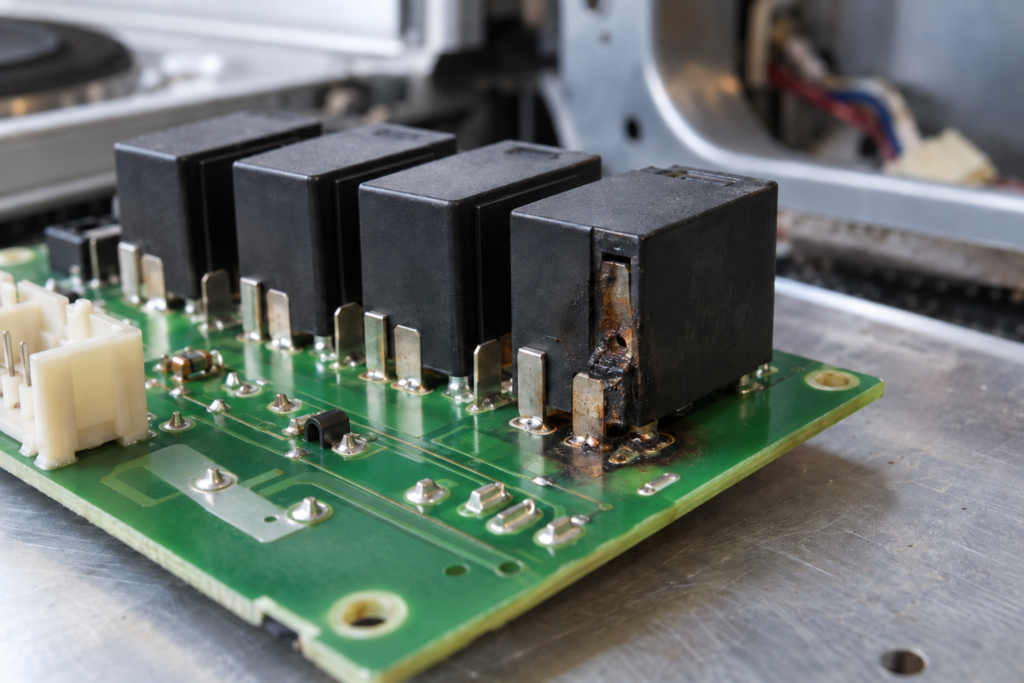
Because of high inrush current each time an element switches on, which over thousands of cycles can fuse the contacts together. High-wattage elements make it worse. The dual-ring or power-boost element in a rear position on a Commercial-Style range draws more inrush current than a standard element, which speeds up relay wear.
- Welded contacts: the usual cause, from repeated high-inrush switching.
- A failed relay driver circuit: the control keeps the relay energized no matter what the software commands.
- A high-resistance bake element: an element that is starting to fail draws abnormal current spikes that accelerate the damage.
- A separate surface element relay board: on many electric ranges, a failure of one relay on that board produces the code.
KitchenAid Range Relay Board Repair or Replace: What Decides It
For a relay fault, repair means replacing a board, and the real choice is whether the range deserves one. Surface element relays often sit on a separate relay board, which is a smaller part than the main control board, while a stuck bake relay on the control board itself means the control board is replaced. Our parent guide, KitchenAid range repair or replace, explains how age and range type set the line.
- Commercial-Style ranges (KFDC and KFGC): built to be repaired, with a service life that justifies repair well past 15 years.
- Standard freestanding and slide-in ranges: normal economics, usually around the 13-year mark, so weigh the board against the machine's age.
- Cabinetry fit: Commercial-Style cutouts are sometimes unique to specific model years, which makes replacing one harder than it looks.
- Several faults at once: a range that shows multiple unrelated faults in a year is approaching end of life.
The practical rule is that a single relay fault on a range that is otherwise healthy is a repair, and a relay fault arriving with other failures on an older standard range is the moment to price a replacement.
How the Fault Is Confirmed
A technician confirms a stuck relay by watching whether the element heats when the control says it should be off. The site's own check is the same idea at the circuit breaker: with power restored briefly, a bake element that glows within seconds, before any key is pressed, shows the relay is stuck. That is a test for a technician to run, since it energizes a faulty circuit.
- The element heats with the control at Off: relay contacts are welded closed.
- The element heats at power-up before any key press: the same fault, seen from the other direction.
- The code appears only when the range tries to switch the element off: a relay that will not open.
Making Sure the New Board Lasts
A new relay board will fail the same way if the cause is still there, so the repair should include a look at the element. A weakening bake or surface element draws the spikes that weld relays, and replacing the board without testing the element invites a repeat.
- Ask for the element to be tested for resistance at the same visit.
- Ask whether the control board was tested as well, since F7 codes can originate on either board.
- Ask for the repair to be warranted, so a repeat failure is covered.
The F7 codes are closely related to the surface element behavior in our KitchenAid range F7 E5 and F7 E6 pages, and the oven version is on the F7 E1 page. A different range code, F1 E0, is the control board's memory failing, and it is covered on its own page.
Getting a Diagnosis
Do not run the range while the code is showing, and do not try to open the control board yourself. Our KitchenAid range repair service tests the relay board, the control board and the elements in the same visit, so the quote names the real part.
A diagnostic visit starts from $95, and the final price is confirmed after the on-site diagnosis, with a written estimate before work begins. Book a visit or send us the exact code and the range model, and we will tell you which side of the line it usually falls on.